 Angela Rossi
Patients now ask ChatGPT, Perplexity or Google's AI Overviews about braces and aligners before they ever call a practice. The answer they get usually carries links. We wanted to know who those links point to: practices, brands, associations, or health media.
This is Dentalog study #1. The data comes from Ahrefs Brand Radar, US prompt database, pulled 3 November 2026. For the SEO work that sits behind those citations, read our guide to dental SEO in 2026.
What we looked at
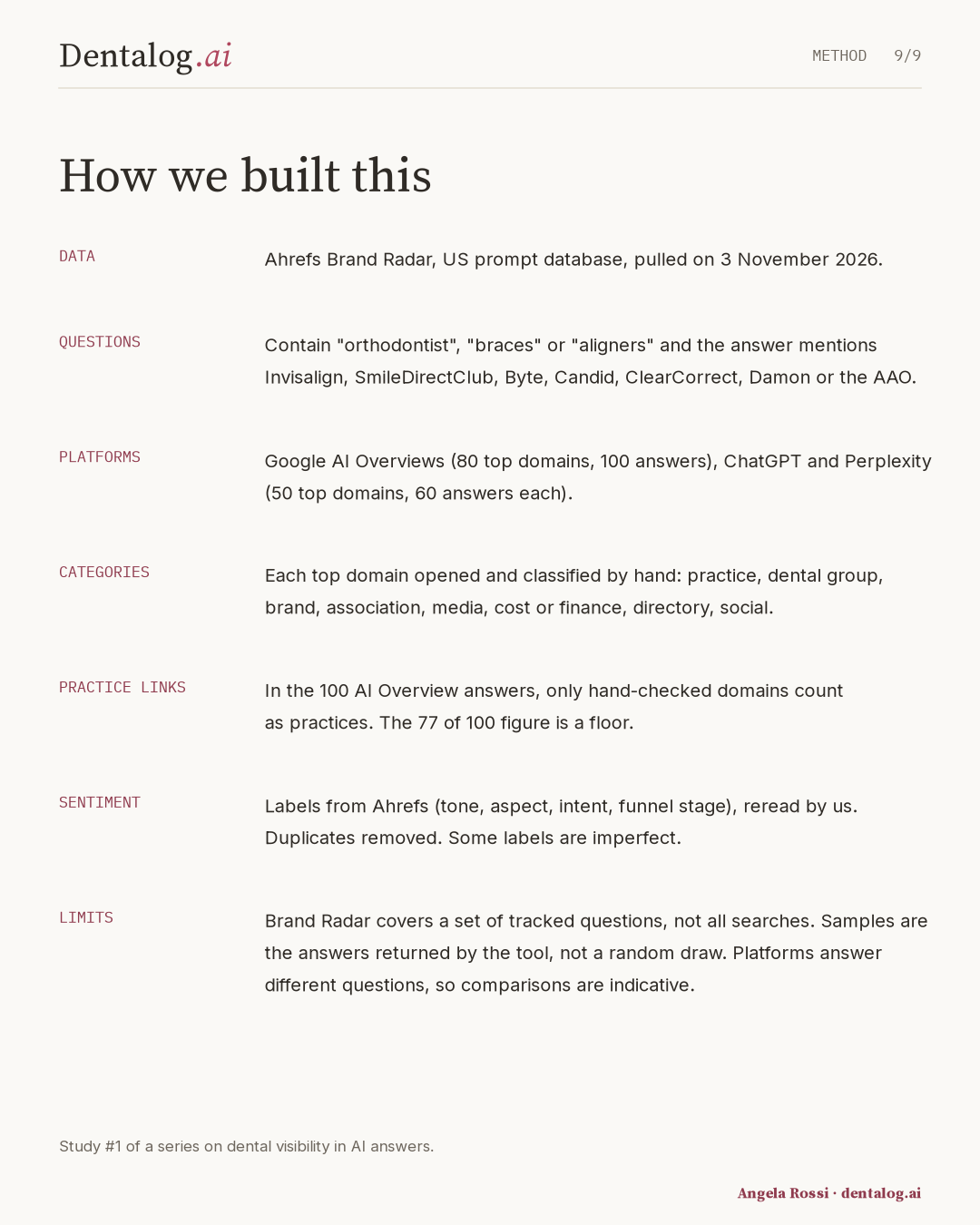
We took answers from the Ahrefs Brand Radar US prompt database for questions containing "orthodontist", "braces" or "aligners", where the answer mentions Invisalign or one of SmileDirectClub, Byte, Candid, ClearCorrect, Damon or the American Association of Orthodontists (AAO).
- Google AI Overviews: 100 answers, 1,066 links, top 80 cited domains (top 50 used for shares)
- ChatGPT: 60 answers, top 50 cited domains, 1,062 citations
- Perplexity: 60 answers, top 50 cited domains, 554 citations
Then we opened every top cited domain (132 unique) and classified it by hand: independent or small-group practice, large dental group (DSO), brand or manufacturer, association / government / research, health media, cost / financing / insurance, directory or review site, video / social / forum. A citation means one answer linking to one domain.
Finding 1: AI Overviews cite practices, a lot
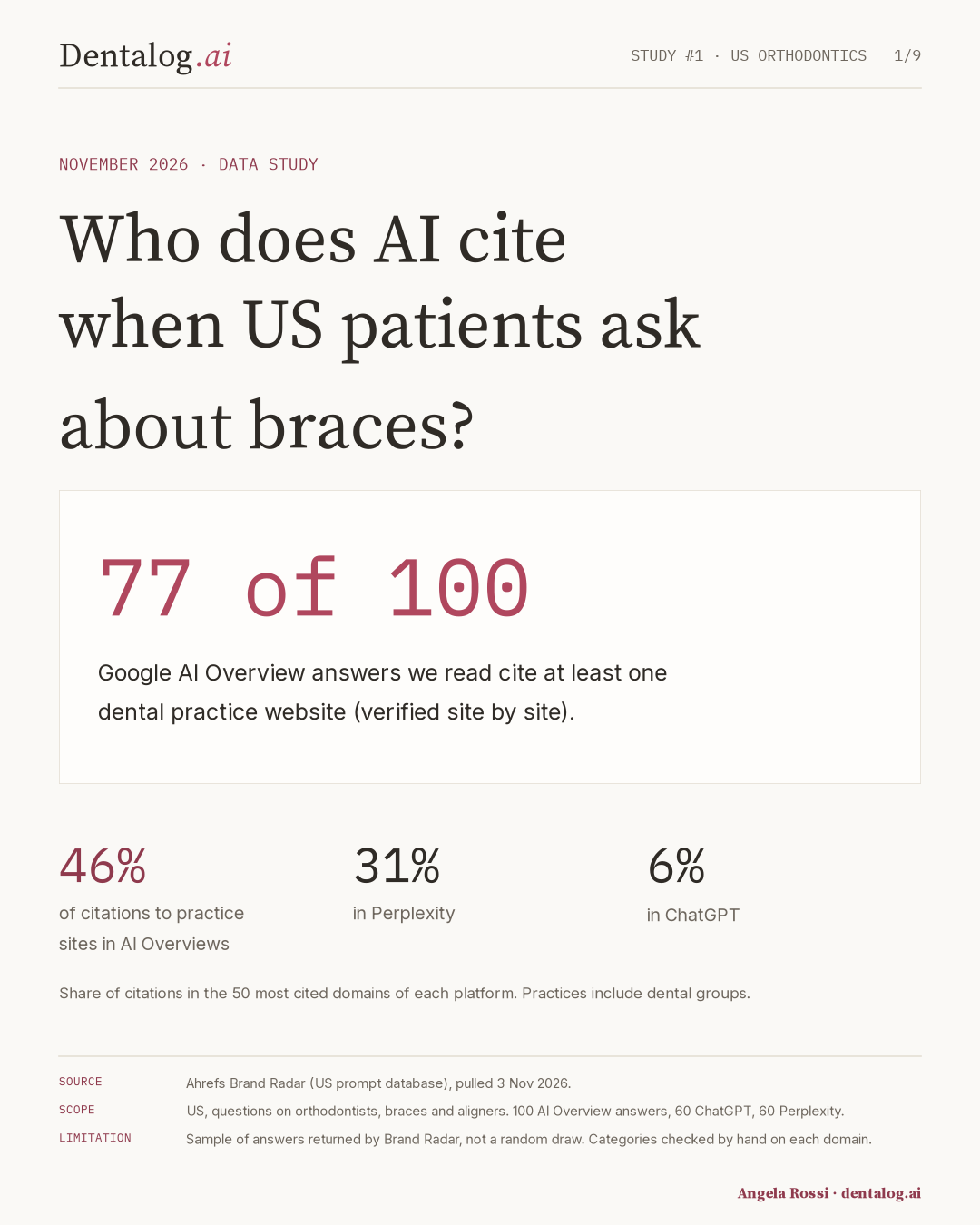
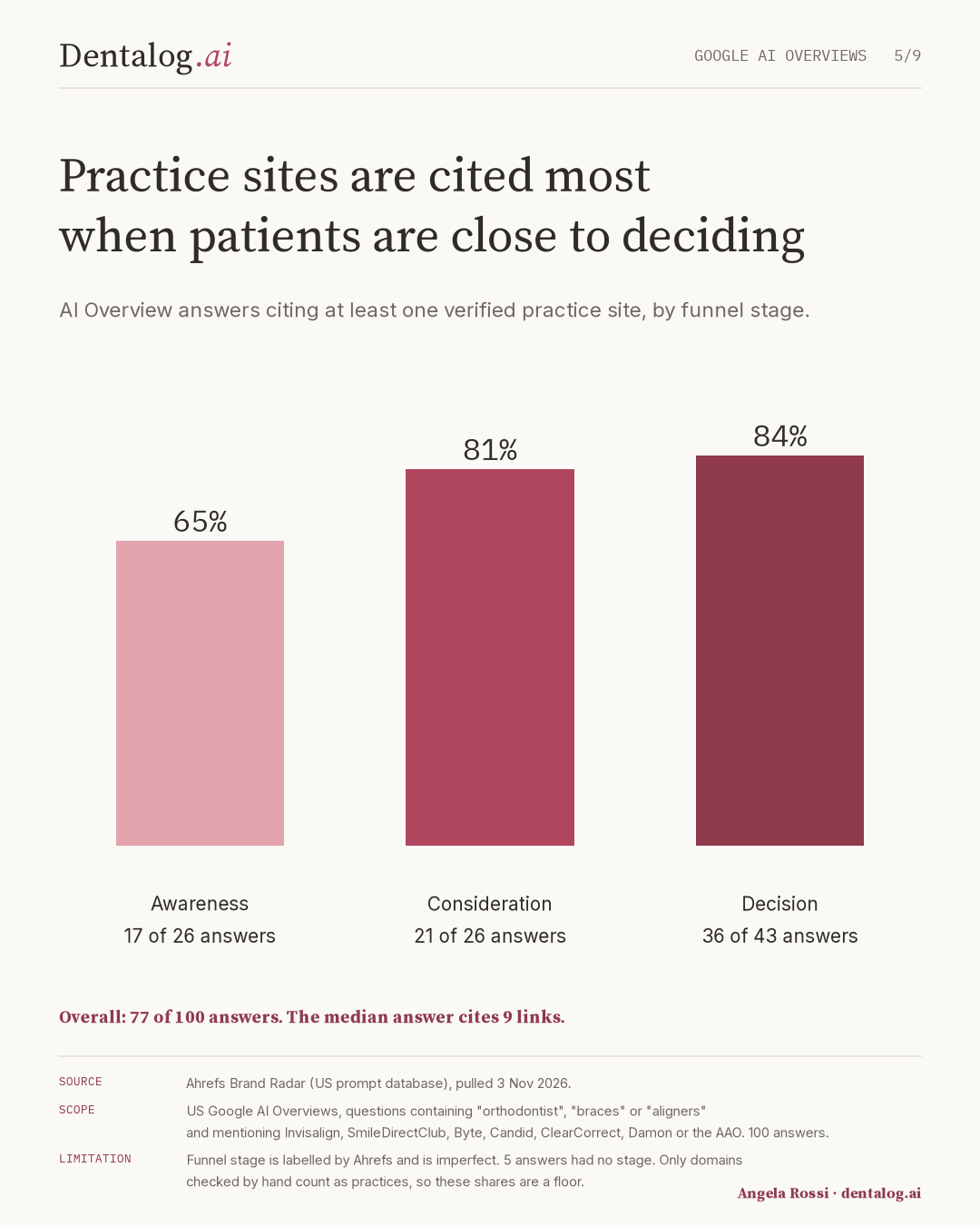
77 of 100 AI Overview answers cite at least one dental practice website. That is a floor, not an estimate: we only counted domains we checked by hand. The long tail (374 domains appearing once or twice) looks mostly like practices too, but we did not count it.
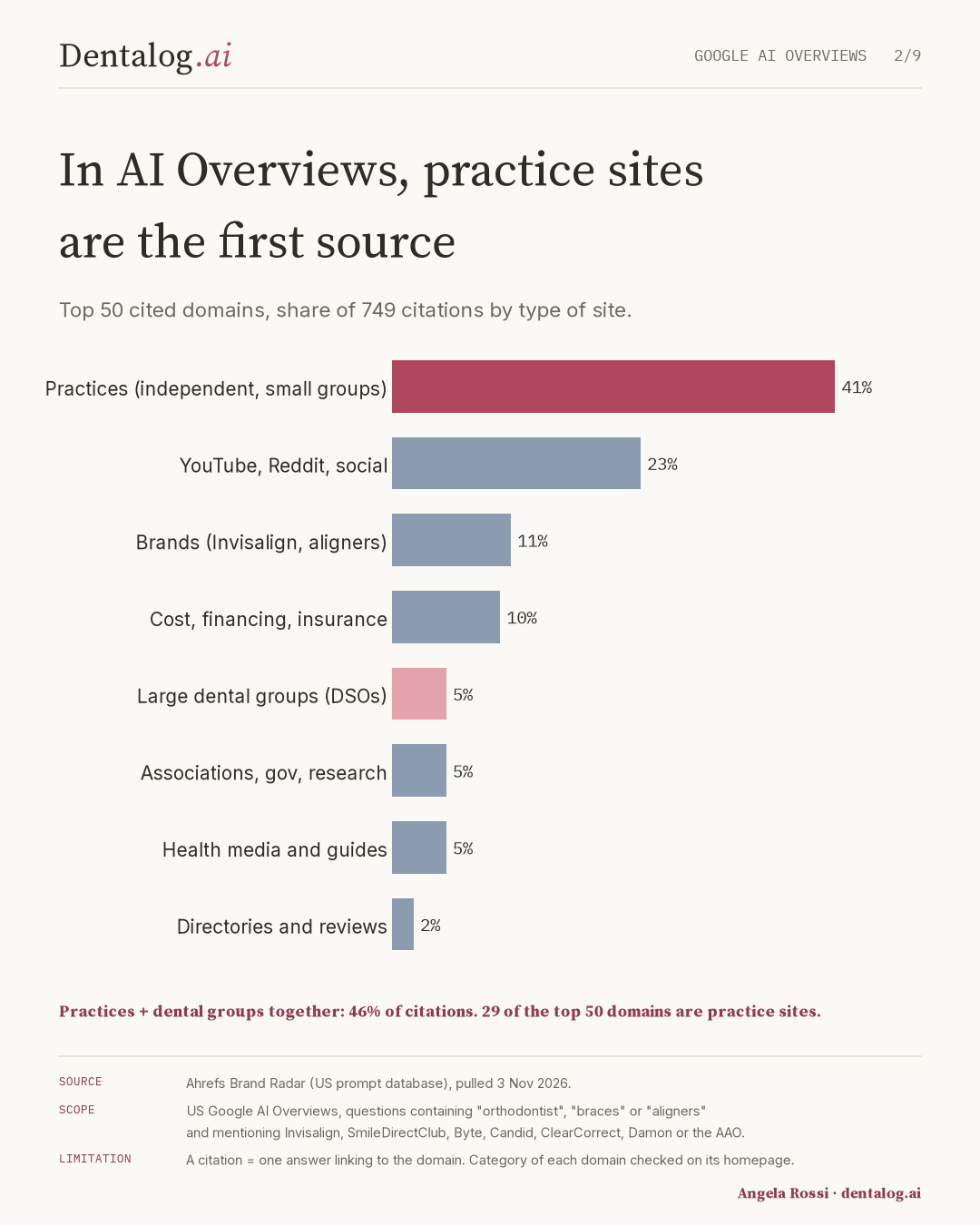
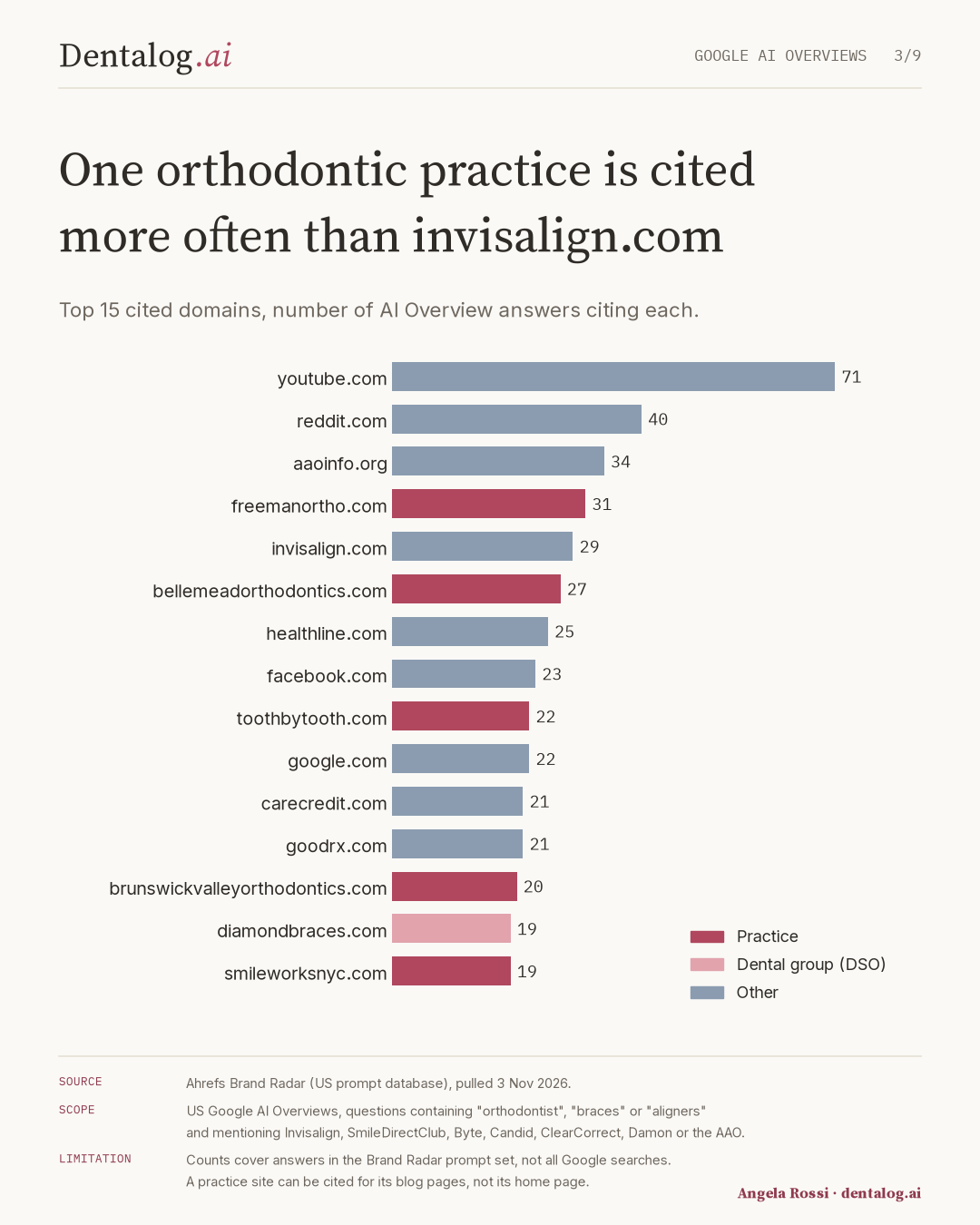
Within the top 50 sources, practices and dental groups take 46% of AI Overview citations. One orthodontic practice, freemanortho.com, appears in 31 answers, more than invisalign.com (29).
For a practice, this is the most useful finding. Google's AI answers do not only quote big brands. A practice page that answers the question clearly can sit next to, or above, the manufacturer.
Finding 2: ChatGPT prefers institutions
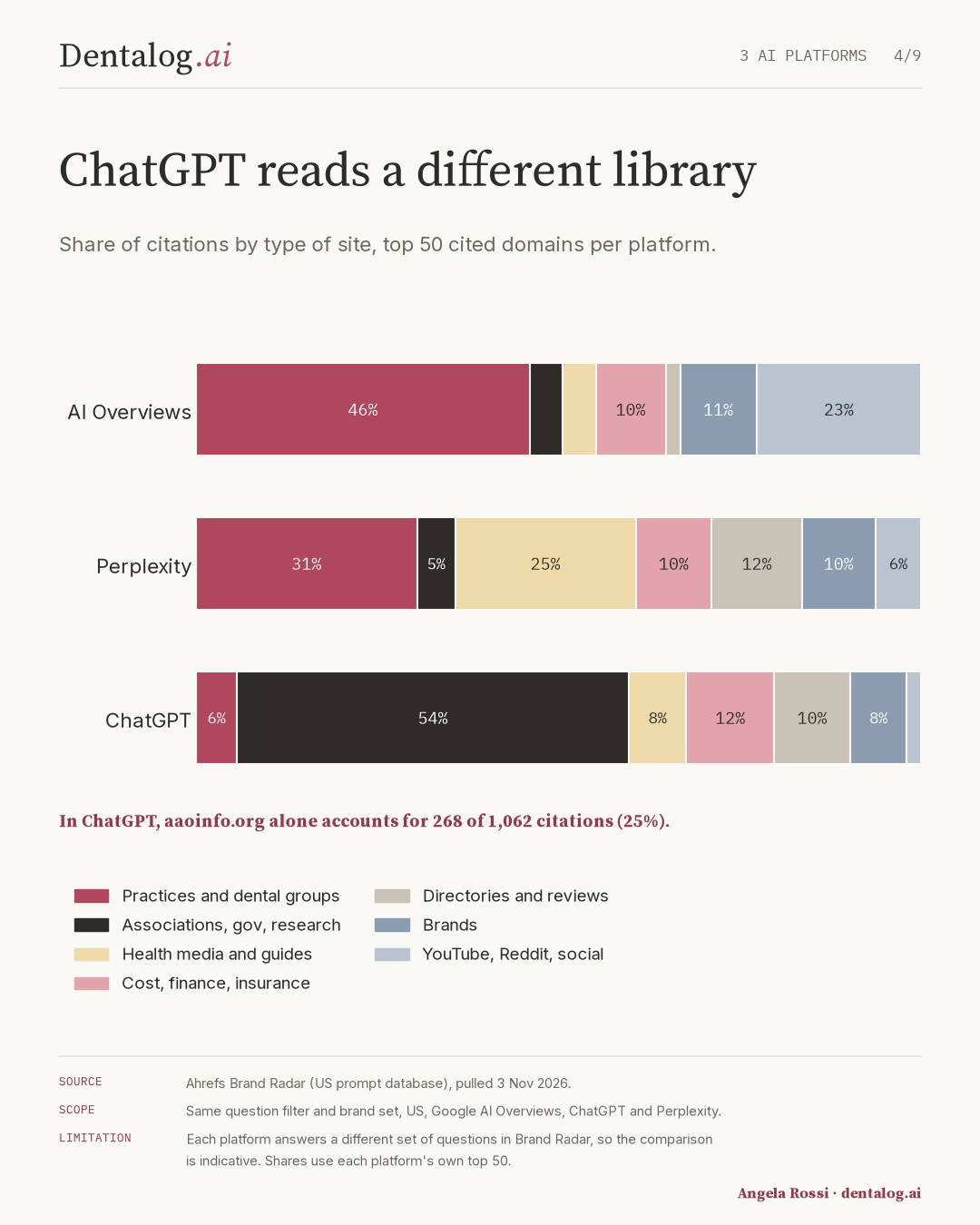
ChatGPT behaves differently. Practices and DSOs take 6% of its top 50 citations. The AAO site alone accounts for 25%. Perplexity sits in between, at 31%.
So "being visible in AI" is not one target. A page that works in AI Overviews may not be picked by ChatGPT, which leans on associations and reference sources. Our guide to AI marketing for dental practices covers how citation works page by page.
Finding 3: Invisalign is talked about neutrally, and mostly about price
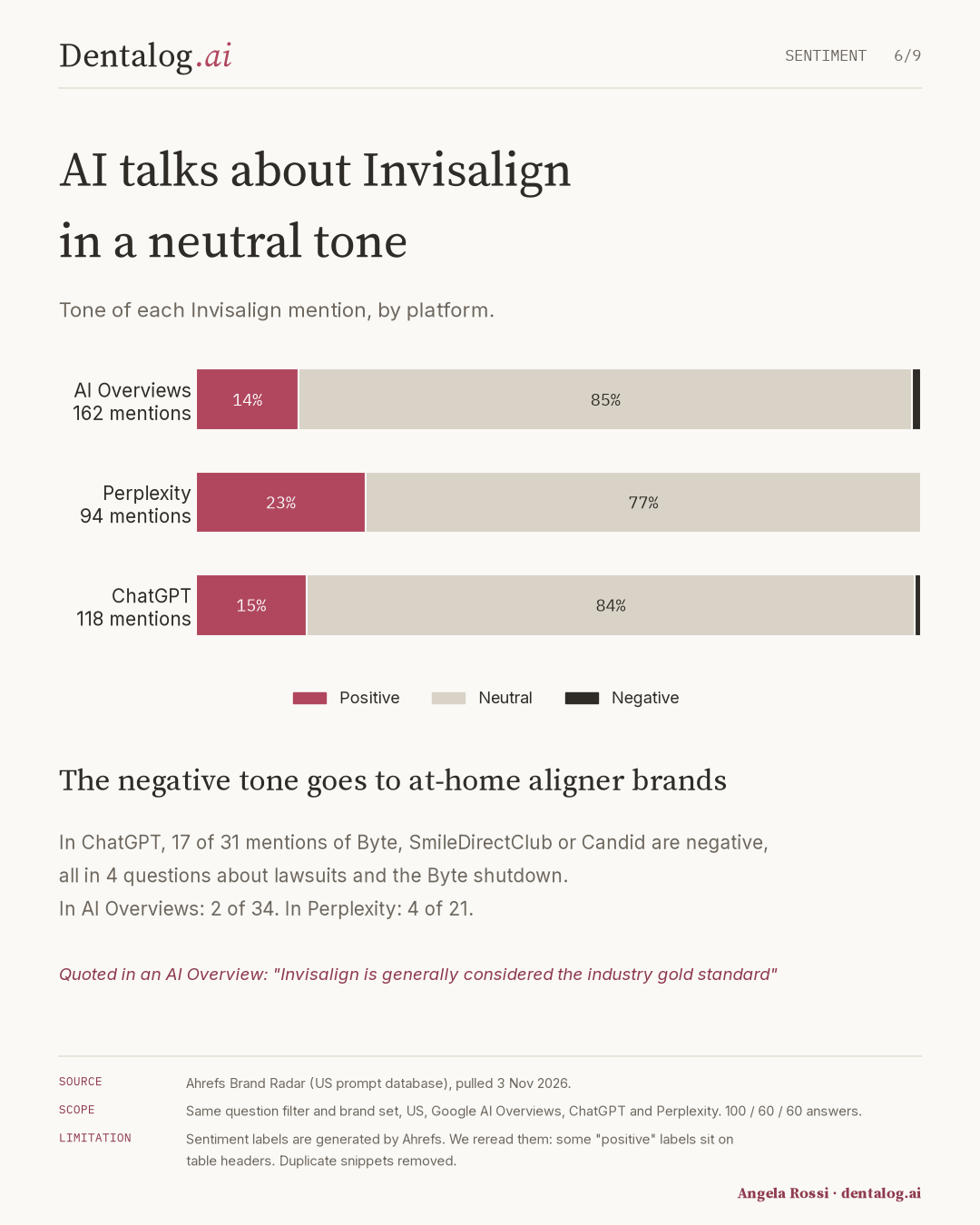
Sentiment around Invisalign is mostly neutral on all three platforms:
| Platform | Invisalign mentions | Positive | Negative |
|---|---|---|---|
| AI Overviews | 162 | 14% | 1% |
| ChatGPT | 118 | 15% | 1% |
| Perplexity | 94 | 23% | 0% |
Negative mentions go to at-home aligner brands: 17 of 31 mentions in ChatGPT, mainly in answers about lawsuits, against 2 of 34 in AI Overviews and 4 of 21 in Perplexity.
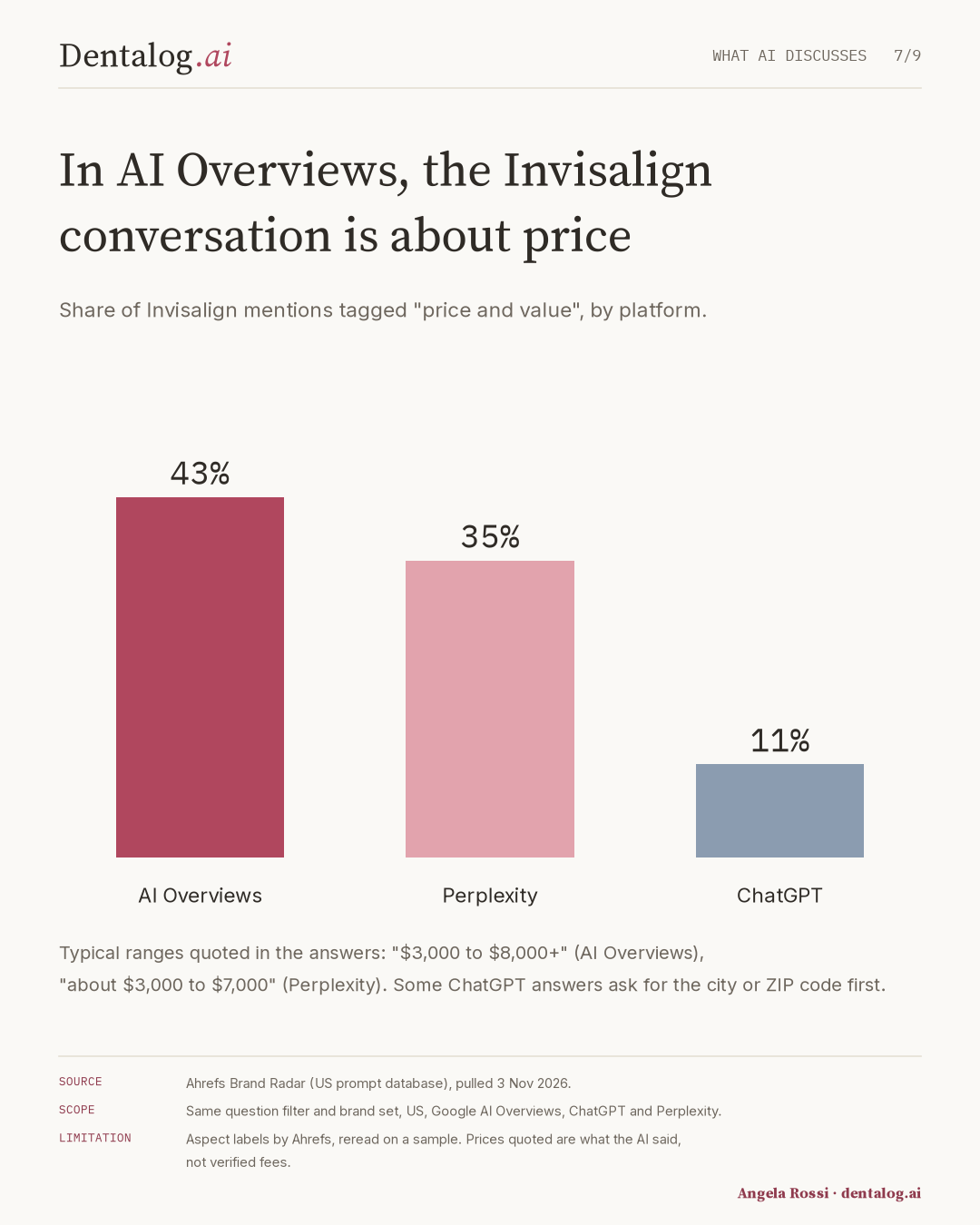
Price dominates the conversation in Google: 43% of Invisalign mentions in AI Overviews are about price and value, against 35% in Perplexity and 11% in ChatGPT. That is why a clear cost page matters, as we cover in the keyword section of the dental SEO guide.
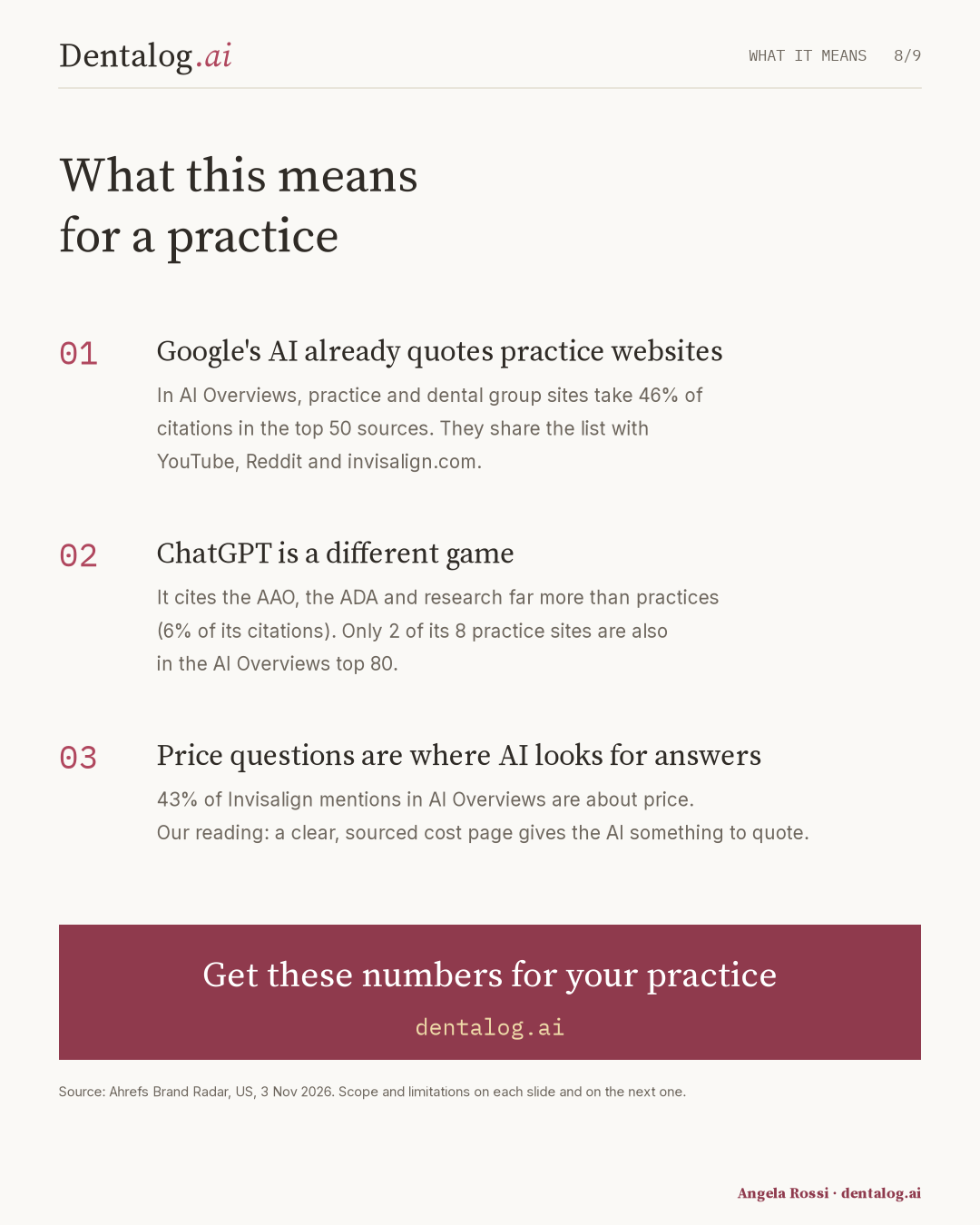
What this means for a practice
- Cost questions are where Google's AI answers look for sources. A clear, dated page on what aligners and braces cost in your area is the page most likely to be quoted. The same idea sits at the centre of orthodontic marketing when adults compare aligners on price.
- For ChatGPT, being consistent with association guidance (AAO) and being described the same way across the web matters more than one strong page.
- Track each platform separately. Our numbers show three different behaviours. For what the surrounding SEO work costs, see how much dental SEO costs.
Charts from the study
The nine slides we published with this study are below. You can also download them as a PDF.
Methodology and limits
- Brand Radar tracks a set of questions, not all searches. Answers are the ones returned for our filter, not a random sample.
- Each platform answers a different set of questions, so cross-platform comparisons are indicative.
- Sentiment, aspect, intent and funnel labels are generated by Ahrefs per brand mention. We removed duplicate snippets and reread labels before quoting; some "positive" labels sit on table headers and a few negatives are mild caveats. Funnel stage is missing for 5 AI Overview answers.
- Prices quoted inside AI answers are what the AI said, not verified fees.
- AI answers change over time. This is a snapshot from 3 November 2026.
- The pull cost about 4,820 Ahrefs API units.
Study #1 of a series on how dental practices show up in AI answers. To see these numbers for your own practice, send us your website. We will reply with a few quick wins based on what we found.